Hyperpersonalization at Scale: How Data, AI, and Identity Graphs Drive Trust-First Customer Experiences

April 3, 2025

Personalization at Scale: Why Data, AI, and Trust Matter More Than Ever
You’ve likely seen the hubbub around machine learning and LLMs being put to work to create scaled, automated, hyper-personalized, one-to-one campaigns.
With global revenue in the customer experience personalization software industry projected to reach $11.6 billion by 2026, a massive tech overhaul is right around the corner.
Yet when it comes to hyperpersonalization, the risks and rewards are amplified.
Make a misstep, and consumer trust can tank.
Get it right, and brands unlock higher engagement and ROI.
As marketers move from viewing LLMs as hypothetical scalability tools to implementing real-world one-to-one use cases, it’s time to revisit a foundational question:
What role does a strong data backbone play in at-scale personalization—and how do you avoid missteps in automated customer interactions?
What Is Personalization at Scale?
Before diving into hyperpersonalization, let’s define what personalization at scale means today.
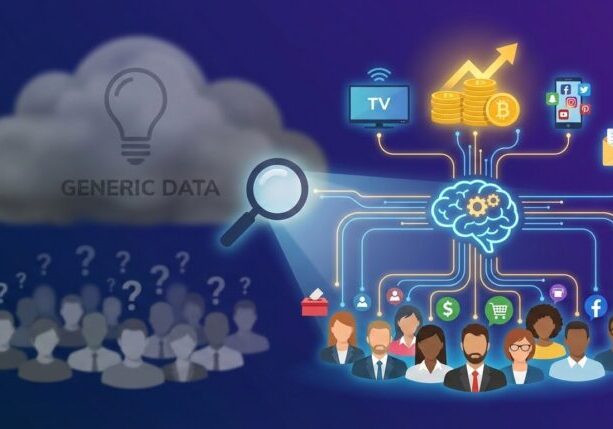
Personalization at scale uses customer data—typically first-party data—verified and refined through an identity graph platform to create unique customer profiles.
These profiles are then used to deliver individualized experiences across multiple channels and touchpoints.
Personalized elements can include:
- Content and messaging
- Product or content recommendations
- Coupons and promotions
- Emails and lifecycle communications
The scaling process is largely automated. Tools such as:
- A/B testing
- Generative AI
- Identity graphs
help brands execute personalization efficiently and consistently.
What Hyperpersonalization Looks Like Today
There are countless modern examples of one-to-one personalization at scale, both within and outside traditional marketing. The strongest examples rely on a foundation of first-party data.
Loyalty programs
Brands like Sephora and Starbucks personalize rewards and promotions based on purchase history and location.
Streaming and CTV platforms
Netflix, Max, and Spotify analyze viewing and listening behavior to deliver tailored content recommendations for each user.
Ecommerce experiences
Amazon uses one-to-one personalization to populate homepages with individualized product recommendations.
Social media platforms
Algorithms serve content users are likely to engage with—and increasingly, products they are likely to buy.
Lifecycle marketing
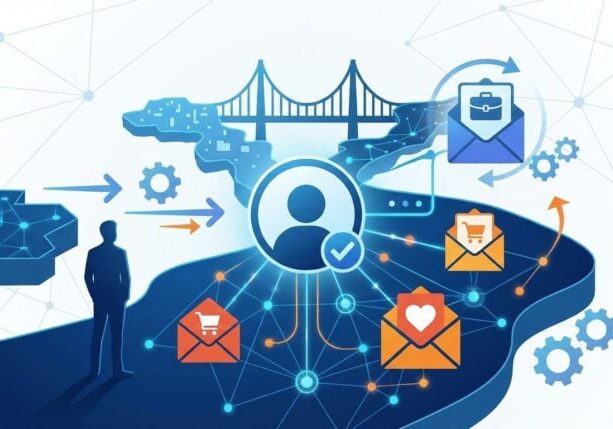
Cart abandonment emails, browse-based product suggestions, and post-purchase follow-ups all qualify as one-to-one personalization.
How Do You Achieve Hyperpersonalization at Scale?
At-scale personalization today depends heavily on first-party data. Here’s how the process works end to end.
Start With Data-Driven Insights
As with most marketing strategies, personalization begins with data.
First-party data typically forms the foundation. Zero-party data—such as information gathered through surveys—can add even more clarity.
This data should then be refined through an identity graph partner to create unified customer profiles. These profiles allow brands to reach the same customer seamlessly across channels and devices.
Automation and AI
Machine learning and AI make it possible to process massive data sets, predict user behavior, and deliver personalized experiences in real time.
Identity graphs already rely on algorithms to resolve identities. Now, emerging technologies—such as agentic AI and LLMs—are expanding hyperpersonalization capabilities even further.
Historically, marketers relied on broad segments and manual personalization. That approach limited scalability.
Every additional segment meant more time, cost, and creative production. Eventually, increased segmentation stopped making financial sense.
Generative AI changes that equation.
By automating creative generation and personalization at scale, brands can increase granularity without exponentially increasing cost.
Omnichannel Personalization
Segmentation still matters. However, combining multiple segments allows for far more nuanced targeting.
With the support of an identity graph partner, brands can:
- Reach users across channels and devices
- Maintain consistency across touchpoints
- React to behavior in near real time
Add automated recommendations and LLM-driven creative support, and brands move closer to true one-to-one personalization.
What If Customers Find It “Creepy”?
The risk of crossing the “creepy” line should be top of mind for every marketer—especially with growing enthusiasm for one-to-one personalization.
Just because personalization is possible doesn’t mean it’s always appropriate.
According to SmarterHQ:
- Over 60% of customers will cut ties with a brand after a creepy interaction
- 68% will tell friends and family about it
At the same time, a McKinsey study shows 71% of customers expect personalized interactions.
So how do brands strike the right balance?
Respect Privacy—Always
Privacy is the foundation of trust.
That means:
- Following all relevant privacy regulations
- Securing customer data
- Respecting user consent and preferences
Not every customer wants the same level of personalization. Brands should:
- Offer opt-out options
- Allow users to adjust personalization settings
- Be transparent about how data is used
Personalization works best when it feels helpful—not invasive.
What’s Next for Hyperpersonalization?
Marketers have spent years discussing how generative AI will transform the industry.
More scalability.
More granularity.
More speed.
Yet many marketers remain cautious.
Nearly one-third of CMOs avoid using genAI in marketing campaigns altogether.
Avoiding the technology eliminates certain risks, including poor data hygiene and rushed implementation. However, it also increases the risk of falling behind.
Rather than skipping genAI entirely, a more sustainable approach may be to:
- Strengthen data quality and governance
- Verify and unify customer data
- Experiment thoughtfully with LLM-driven personalization
For the 70% of CMOs already using genAI, the path forward is clear.
As one-to-one use cases accelerate, maintaining strong data hygiene, privacy standards, and customer-centric decision-making will be essential to long-term success.
Featured Content